Jewish Wedding Ring Exchange: What to Say and Do
The Jewish wedding ring exchange is one of the most moving moments under the chuppah, and couples often ask: in a Jewish wedding, does only the groom give a ring, or do both partners? The short answer: in a traditional Orthodox ceremony, the groom gives the bride a ring and says the words of kiddushin, and the bride does not give a ring as part of kiddushin. At a Reform ceremony both partners exchange rings and each says words of commitment. Here is what is behind the custom and how to plan your own exchange.
Where the Ring Comes From in Jewish Tradition
According to halacha, kiddushin takes place when the groom gives the bride an item of value in front of two witnesses. The Shulchan Aruch notes that the custom is to use a ring (Even HaEzer 27:1). The Rema adds that the custom is to use a ring without a stone, and that the witnesses are asked whether the ring is worth at least a perutah (Even HaEzer 31:2). That is why the traditional wedding ring is a plain band.
The Words of Kiddushin
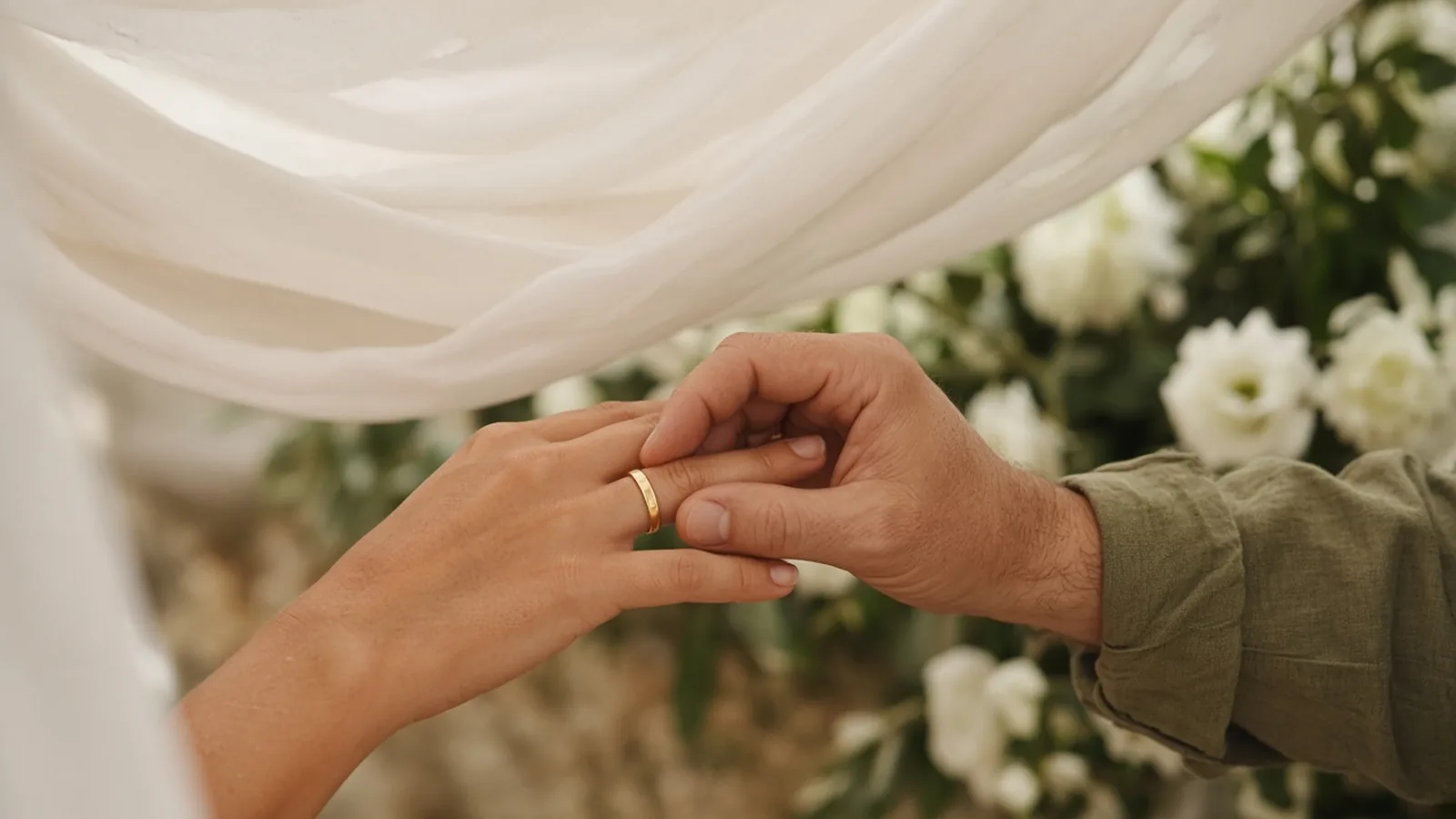
When he places the ring, the groom says: “Harei at mekudeshet li b’taba’at zo k’dat Moshe v’Yisrael”, which means “Behold, you are consecrated to me with this ring, according to the law of Moses and Israel.” This is the moment of kiddushin itself.
To see where this fits in the whole ceremony, read the Jewish wedding ceremony order, step by step.
Which Finger?
There are different customs about which finger the ring goes on during kiddushin and afterward. Talk it over with the rabbi in your preparation meeting, so there is no hesitation under the chuppah. What matters most is that the ring slides on easily.
A Mutual Ring Exchange at a Reform Wedding
At a Reform ceremony, both partners give each other a ring and both say words of commitment. The Israeli Reform movement’s wedding site describes mutual kiddushin, with a ring, another object or a document (stages of the ceremony, Reform movement, Hebrew). This is part of the spirit of a Reform Jewish ceremony, where both partners stand equally.
What Does the Bride Say?
There are several options. Some brides use the matching form, “Harei atah mekudash li”, and some choose a verse such as “I am my beloved’s and my beloved is mine” from the Song of Songs. Others add a personal sentence of their own. We will decide together on the wording that suits you.
Two Grooms or Two Brides
At a wedding of two grooms, each says “Harei atah mekudash li”. At a wedding of two brides, each says “Harei at mekudeshet li”. Both partners give a ring, and the ceremony is fully mutual. You can add a personal sentence before or after.
Choosing Rings
- Plain or decorated? For a traditional ceremony, a plain band without stones is customary. At a Reform ceremony there is more flexibility, so ask your rabbi.
- Matching or different? Some couples want identical rings, others prefer rings that suit each partner.
- Engraving. A date, a verse or your initials on the inside of the ring adds a personal touch.
- Size. Make sure the ring slides on easily. Fingers swell on a hot day.
Who Holds the Rings?
Some couples give the rings to a witness or a close friend, some to a child, and some simply keep them with the rabbi. Just decide in advance, so no one searches their pockets at the big moment.
The Ring and the Ketubah
After the kiddushin, the ketubah is read aloud. In an egalitarian ketubah, both partners take on commitments toward each other, which fits naturally with a mutual ring exchange. Read more about the egalitarian ketubah.
Frequently Asked Questions
Can we use a ring with a stone?
In a traditional ceremony the custom, per the Rema, is a ring without a stone. Some couples use a plain ring under the chuppah and wear the engagement ring afterward.
Can the bride give the groom a ring at an Orthodox wedding?
In Orthodox practice, the bride’s ring is not part of the kiddushin. Ask your rabbi whether and when it can be given.
Do we have to use rings?
Halacha requires an item of value, and the custom is a ring. The Reform movement’s wedding site also mentions kiddushin with another object or a document, so we can talk about alternatives.
In Summary
The ring exchange is a brief moment, but it carries centuries of tradition. In an Orthodox ceremony the groom gives the ring, and at a Reform ceremony both partners give rings to each other as equals. If you would like a ceremony where both of you make your commitment out loud, you are welcome to contact the rabbi.
More Articles for Couples