What Is an Egalitarian Ketubah? How It Differs From a Traditional One
What is an egalitarian ketubah? The short answer: an egalitarian ketubah is one in which both partners make mutual commitments to each other, instead of the traditional ketubah in which only the groom makes commitments toward the bride. It is usually written in Hebrew, sometimes with another language alongside, and expresses values of partnership, respect and love. In this article I explain the difference between a traditional and an egalitarian ketubah, what is usually included in one, and how to adapt it to you. You will find the texts themselves on the page of ketubah texts for your wedding, so that you can browse them and choose.
What Is a Traditional Ketubah?
The ketubah is one of the oldest documents in Jewish tradition. The traditional ketubah is written in Aramaic, and it is mainly a document of the groom’s obligations toward the bride: to honor her, to provide for her, and to guarantee her a set sum in case of divorce or death. In its time, the ketubah was an innovation that protected women. Today, many couples feel that this wording does not reflect their relationship, in which both partners are equal.
What Makes a Ketubah Egalitarian?
An egalitarian ketubah keeps the spirit of the ketubah as a covenant between the partners, but changes its structure. Instead of one side making commitments and the other receiving them, both partners commit together. It usually includes:
- Mutual commitment: both partners promise to respect, support and love each other.
- Accessible language: clear Hebrew, sometimes with a translation into another language.
- Shared values: friendship, honesty, an open home, family, community, or other values that matter to you.
- Room for the personal: some couples add a personal sentence or a favorite quotation.
- Signatures: the couple, the witnesses and the rabbi sign the ketubah.
Why Couples Choose an Egalitarian Ketubah
The reasons vary from couple to couple, but some come up again and again. Some couples feel that a traditional ketubah, in which only one side commits, does not match how they live: both work, both raise the children, both make decisions together. Some couples want to understand every word read under the chuppah, so they prefer Hebrew, English or another language their guests understand. And for some couples there is no “groom” and “bride” in the traditional sense, for example same-sex couples, so the traditional wording simply does not fit.
For all these couples, an egalitarian ketubah makes it possible to keep an ancient and meaningful custom while saying something true about their relationship. It is not giving up on tradition; it is a way of continuing it.
Traditional and Egalitarian Ketubah: The Differences
- Language: traditional in Aramaic; egalitarian usually in Hebrew, with another language if you choose.
- Who commits: in the traditional one, the groom; in the egalitarian one, both partners.
- Content: the traditional one has defined financial obligations; the egalitarian one has commitments of values and feelings.
- Witnesses: traditionally two observant men; in a Reform ceremony women can also be witnesses.
- Flexibility: the traditional wording is fixed; egalitarian ketubot come in a range of texts, and you can adapt them.
Is an Egalitarian Ketubah Legally Binding?
This is an important question. An egalitarian ketubah is a document of values and feelings, and a meaningful anchor in the ceremony. However, it does not replace a prenuptial agreement and does not, on its own, set financial rights. If you want to settle rights and property in a binding way, draw up a prenuptial or cohabitation agreement with a lawyer. The information here is general and is not legal advice.
How to Adapt an Egalitarian Ketubah to the Two of You
Read Several Texts
There are several accepted texts for an egalitarian ketubah, and each one emphasizes slightly different values. Read a few of them together and mark the sentences that speak to you. A selection of egalitarian, traditional and liberal ketubah texts appears on a separate page of the site.
Think About Your Guests
The ketubah is read aloud under the chuppah. If some guests do not speak Hebrew, consider a bilingual text.
Adapt It to Your Family
Some couples want to keep a link to the traditional ketubah, for example by including a sentence in Aramaic or keeping the general structure. You can choose a text that connects the two worlds.
Consult the Rabbi
In the preparation meetings you can go over the text together, ask questions and adapt it. That way the ketubah will be faithful both to tradition and to you.
The Ketubah as an Object for Your Home
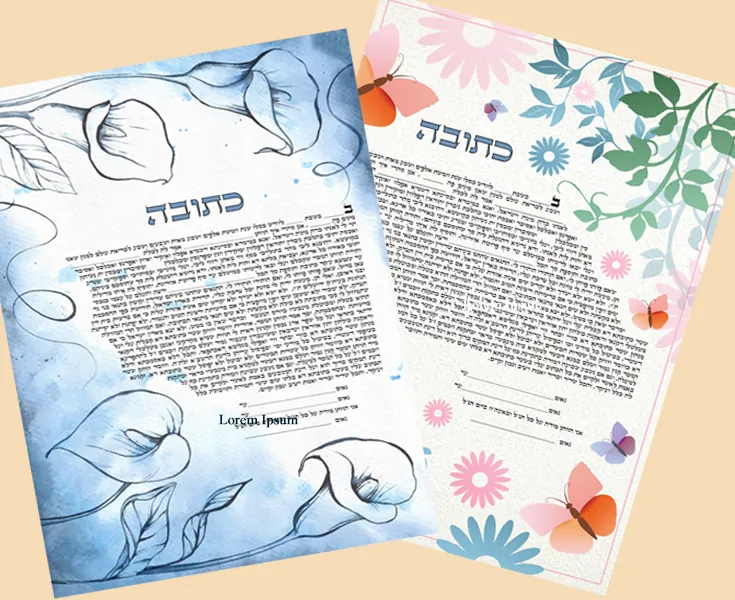
After the wedding, many couples hang the ketubah at home. So it is worth thinking about the design too: an artistic ketubah with illustrations, colors and a suitable frame becomes a keepsake that stays with you for years. You can see examples of designed ketubot for your wedding and choose a design that suits your home.
When Do You Write It and When Do You Sign It?
Choose the text a few weeks before the wedding, so there is time to write, design and check the details: full names, the Hebrew and civil dates, the place of the ceremony and the names of the witnesses. The signing usually takes place before the chuppah, in the presence of the witnesses and the rabbi, and the reading during the ceremony.
Common Mistakes When Choosing a Text
- Leaving the choice to the last minute: a designed ketubah needs preparation time, and the text itself needs thought.
- Not checking the details: a mistake in a name or a date is not something you want to discover under the chuppah. Ask to see a draft and check it carefully.
- Writing a text that is too long: the ketubah is read aloud. A focused text sounds better and is remembered better.
- Confusing a ketubah with an agreement: binding financial commitments belong in an agreement drawn up with a lawyer, not in the ketubah.
- Not writing it together: an egalitarian ketubah is written together, because it is the commitment of both of you.
Frequently Asked Questions
Is an egalitarian ketubah only for a Reform ceremony?
Egalitarian ketubot are common mainly in Reform, Conservative and secular ceremonies. The Rabbinate uses the traditional ketubah.
Can we write a completely personal ketubah?
Yes, in a Reform or secular ceremony you can write a personal text. It helps to work with the rabbi to keep a clear structure and a link to tradition, if that matters to you.
Does an egalitarian ketubah suit a same-sex couple?
Yes. An egalitarian ketubah suits same-sex couples especially well, because it does not assume the roles of groom and bride.
Who signs an egalitarian ketubah?
Usually both partners, two witnesses, and the rabbi or whoever leads the ceremony.
Can an egalitarian ketubah include Aramaic?
Yes. Some texts combine sentences in Aramaic alongside Hebrew, to keep a link to the traditional ketubah.
Can a ketubah be written in two languages?
Yes. A bilingual ketubah, for example in Hebrew and English, works especially well when one partner or part of the family does not speak Hebrew. That way everyone can understand the text when it is read under the chuppah.
In Summary
An egalitarian ketubah is a way to keep one of the oldest documents in Jewish tradition while expressing your relationship in it, as a partnership of two equals. Read texts, choose together, and adapt them to you. If you would like help choosing a text and building the whole ceremony, you can contact the rabbi.
More Articles for Couples