Jewish Wedding Witnesses: Who Can Serve and What They Do
Jewish wedding witnesses play a small but essential role in the ceremony, and many couples are not sure who can serve. The short answer: at an Orthodox wedding you need two adult male witnesses who are not related to the couple and who keep the commandments. At a Reform wedding, according to the Reform movement, witnesses can be men and women equally. This guide explains what witnesses do, how the different streams see it, and how to choose people you love.
How Many Witnesses, and What Do They Do?
According to halacha, kiddushin takes place in front of two witnesses. The Shulchan Aruch describes the giving of an item of value “before two”, and notes the custom of using a ring (Even HaEzer 27:1). The witnesses see the moment of kiddushin and, in most weddings, also sign the ketubah.
Put simply, witnesses are the people who can say: “We saw it, and we were there.” It is a role of trust and honor.
What Witnesses Do on the Day
- Sign the ketubah, usually before the chuppah.
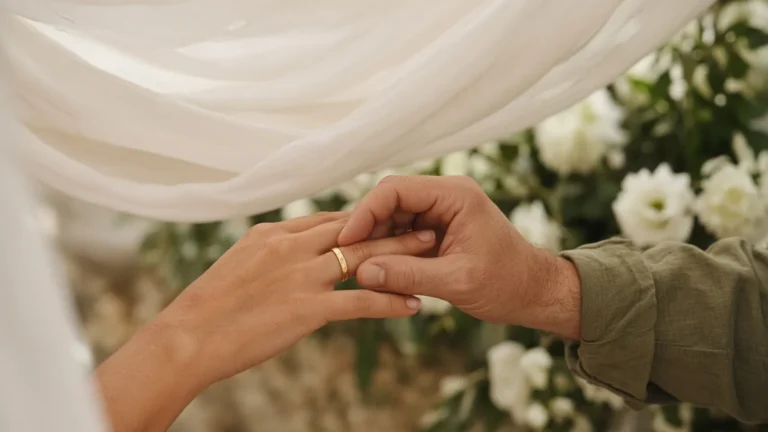
- Stand close to the couple during kiddushin to see the ring given and hear the words.
- In Orthodox practice, the rabbi asks them whether the ring is worth at least a perutah, as the Rema records (Even HaEzer 31:2).
To see where this fits in the whole ceremony, read the Jewish wedding ceremony order, step by step.
Who Cannot Be a Witness in Orthodox Practice?
Relatives
The Shulchan Aruch lists relatives who are disqualified as witnesses (Choshen Mishpat 33:1). So in Orthodox weddings, the couple’s parents, siblings, uncles and brothers in law do not serve as witnesses.
Women
According to the Shulchan Aruch, a woman is not a valid witness (Choshen Mishpat 35:14). That is why at an Orthodox wedding the witnesses are men only.
People Who Do Not Keep the Commandments
The Shulchan Aruch disqualifies someone who commits certain transgressions (Choshen Mishpat 34:2). In practice, the Israeli Rabbinate expects witnesses who are religiously observant. So when couples ask, “Can my best friend, who is secular, be a witness?”, at an Orthodox wedding the answer is usually no.
Witnesses at a Reform Wedding
Here the picture is different. The Israeli Reform movement’s wedding site says the ketubah witnesses are “men and women equally”, and that a couple can choose a male and a female witness (stages of the ceremony, Reform movement, Hebrew). The Union for Reform Judaism in North America also notes that witnesses can be of any gender, and that many clergy prefer witnesses who are not relatives.
So at a Reform wedding you can choose your best friend, or the secular friend who has been with you all along. This is part of the spirit of a Reform Jewish ceremony, where both partners are full participants.
How to Choose Your Witnesses
- Someone who knows you as a couple. A witness is more than a signature. It is someone who watched your relationship grow.
- Balance between families. Many couples choose one witness from each side.
- Reliability on the day. Witnesses need to arrive on time for the ketubah signing.
- A clear conversation in advance. Tell them what the role involves, so they feel comfortable.
- Language. If a witness does not read Hebrew, the rabbi can explain what they are signing.
What Do Witnesses Sign in the Ketubah?
The witnesses sign at the bottom of the ketubah, confirming that what it describes took place in front of them. In an egalitarian ketubah, both partners commit to each other and the witnesses attest to it. Read more about the egalitarian ketubah.
Frequently Asked Questions
Can a woman be a witness at a Jewish wedding?
At an Orthodox wedding, no, according to the Shulchan Aruch. At a Reform wedding, yes: the Reform movement says witnesses can be men and women equally.
Can a sibling or in law be a witness?
Under Orthodox halacha, relatives are disqualified. At a Reform wedding there is more flexibility, but many rabbis prefer non relatives, so ask your rabbi early.
Can we have more than two witnesses?
You can honor more people with other roles: a blessing, a reading or holding a chuppah pole.
Does a witness have to be Jewish?
In Orthodox practice, witnesses are expected to be observant Jewish men, as described above. In liberal settings, practice varies between rabbis and communities, so discuss it in advance.
In Summary
Witnesses take only a few minutes of the ceremony but carry real meaning. Orthodox rules are strict, while a Reform wedding leaves room to choose the people closest to your heart, women and men alike. If you would like a ceremony where everyone important to you has a place, you are welcome to talk to the rabbi.
More Articles for Couples